Monday, 26 August 2013

Multithreaded programming

In multithreaded programming, a thread is sometime required to block until some condition is true. In thread systems pre-dating Java, this mechanism is generally called "condition variables" and corresponds to a separately allocated object. For example using the pthread library, you do create and use a condition variable like this:
pthread_cond_t count_threshold_cv;
pthread_mutex_t count_mutex;
pthread_cond_wait(&count_threthold_cv, &count_mutex); // atomically unlock mutex while waiting
phtread_cond_signal(&count_threthold_cv);
When locks and condition variables are used together, the result is called a monitor:

  • A collection of procedures manipulating a shared data structure.
  • One lock must be held whenever accessing the shared data
  • One or more condition variables used for waiting.
In C#, there is no separate type for the condition variable. Instead every object inherently implements one condition variable, and the "Monitor" class provides static "Wait", "Pluse" and "PulseAll" methods to manipulate an object's condition variable. They are used together with lock or Monitor.Entor and Monitor.Exit.
public static KV GetFromList() {
  KV res;
  lock (typeof(KV)) {
    while (head == null) Monitor.Wait(typeof(KV));
    res = head; head = res.next;
    res.next = null; // for cleanliness
  }
  return res;
}

In C# every object also inherently implements a mutual exclusion lock.

Friday, 23 August 2013

Windows 7 shortcut


  • Win+Home: Clear all but the active window.P
  • Win+Space: All windows become transparent so you can see through to the desktop.P
  • Win+Up arrow: Maximize the active window.P
  • Shift+Win+Up arrow: Maximize the active window vertically.P
  • Win+Down arrow: Minimize the window/Restore the window if it's maximized.P
  • Win+Left/Right arrows: Dock the window to each side of the monitor.P
  • Shift+Win+Left/Right arrows: Move the window to the monitor on the left or right.
Source:

Monday, 8 July 2013

HHMM and HMM

An HMM is a stochastic finite automaton, where each state generates an observation. The observation can be a discrete symbol or a feature vector. The parameters of the model are the initial state distribution, the transition model, and the observation model. An HMM can be represented by a state transition diagram or by a Bayesian network.

Any HHMM can be converted to HMM. The resulting state-space may be smaller, because it does not contain abstract states. This occurs if there are not many shared sub-structures. The state-space may be larger if there are shared sub-structures because they must be duplicated.  Whether the state-space will be lager or smaller, depends on the ratio between the number of hidden states \(n_h^S\) in  HHMM and the number of hidden states \(n^S\) in HMM.

In general, a dynamic Bayesian network (DBN) can be converted to an HMM if all the hidden nodes are discrete. In this case, using the HMM inference engine can be faster than the using the junction tree inference engine for small models because the constant factors of the algorithm are lower, but can be exponentially slower for models with many variables (e.g.,  > 6 binary hidden nodes).

HMM parameter learning: EM algorithm
n sequences with length m
\begin{align}
t^t(s'|s) = \frac{\sum_{i = 1}^n\sum_{j=1}^m p(S_j = s, S_{j+1} = s'|x_{i, 1}\ldots x_{i, m};\underline{\theta})}{\sum_{i = 1}^n\sum_{j=1}^m \sum_{s'} p(S_j = s, S_{j+1} = s'|x_{i, 1}\ldots x_{i, m};\underline{\theta})}
\end{align}
$$\sum_{s'} t(s'|s) = 1$$

Sunday, 7 July 2013

Ruby on Rails

Association

Auto-generated methods

Singular associations (one-to-one)

| | belongs_to |
generated methods | belongs_to | :polymorphic | has_one
----------------------------------+------------+--------------+---------
#other | X | X | X
#other=(other) | X | X | X
#build_other(attributes={}) | X | | X
#create_other(attributes={}) | X | | X
#other.create!(attributes={}) | | | X
#other.nil? | X | X |
Collection associations (one-to-many / many-to-many)

| | | has_many
generated methods | habtm | has_many | :through
----------------------------------+-------+----------+----------
#others | X | X | X
#others=(other,other,...) | X | X | X
#other_ids | X | X | X
#other_ids=(id,id,...) | X | X | X
#others<< | X | X | X
#others.push | X | X | X
#others.concat | X | X | X
#others.build(attributes={}) | X | X | X
#others.create(attributes={}) | X | X | X
#others.create!(attributes={}) | X | X | X
#others.size | X | X | X
#others.length | X | X | X
#others.count | X | X | X
#others.sum(args*,&block) | X | X | X
#others.empty? | X | X | X
#others.clear | X | X | X
#others.delete(other,other,...) | X | X | X
#others.delete_all | X | X |
#others.destroy_all | X | X | X
#others.find(*args) | X | X | X
#others.find_first | X | |
#others.uniq | X | X | X
#others.reset | X | X | X

Auto completer

Saturday, 6 July 2013

Trianglulate a graph

Triangulation ensures a graph G is triangulated (chordal), i.e., every cycle of length > 3 has a chord. During the process, we can also find maximal cliques in the triangulated graph.

Pseudo code:

// G is moralized.
triangulate(G, order):
1. eliminated = {}
2. cliques = {}
3. for i = 1 : n
       u = order(i)
       nodes = neighbors of u which are not eliminated yet \(\cup\) u
       make every node in nodes all connected to each other
       add u to eliminated
       check whether nodes is a subset of any clique already found, if not, add nodes to cliques.


Tuesday, 2 July 2013

Algorithm complexity

http://bigocheatsheet.com

Shortest path

Dijkstra: \(\Theta(V)\) inserts into priority queue, \(\Theta(V)\) EXTRACT_MIN operations, \(\Theta(E)\) DECREASE_KEY operations.
Min-heap implementation: \(\Theta((V + E)\log V)\)
Fibonacci heap implementation: \(\Theta(\log V)\) for exact min, \(\Theta(1)\) for decrease key and insertion, total amortized cost \(\Theta(V\log V + E)\)

Fibonacci heap


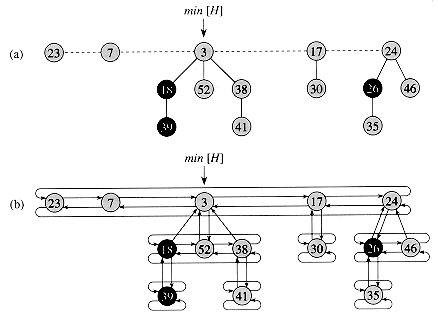
A list of heap-ordered trees. We access the heap by a pointer to the tree root with the overall minimum key.

Main operations

Inserting a node: create a new tree containing only x and insert it into the root list of H.
Decrease-key: cut the node from its parent, then insert the node into the root list with a new key. \(O(1)\)
Delete-min: remove the root of the smallest key, add its children to the root-list, and scan through the linked list of all the root nodes to find the new root of minimum key. We also need need to consolidate the root list by merging roots with the same degree (same number of children). We can think of consolidation as allocating buckets of size up to the maximum possible rank for any root node, which is O(log n). We put each node into the appropriate bucket and march through the buckets, starting at the smallest one, and consolidate everything possible. Therefore the cost of delete-min operation is O(# of children) of the root of the minimum key plus O(# of root nodes).

Population control for roots

We want to make sure that every node has a small number of children. This can be done by ensuring that the total number of descendants of any node is exponential in the number of its children. One way to do this is by only merging trees that have the same number of children (degree).

Let \(s_k\) be the minimum size of any node of degree k in any Fibonacci heap. Let \(y_1, y_2, \ldots, y_k\) denote the children of x in the order in which they were linked to x
\begin{align}
size(x) &\ge s_k \\
& \ge 2 + \sum_{i = 2}^k s_{y_i.degree} \\
& \ge 2 + \sum_{i = 2}^k s_{i - 2} \\
& \ge 2 + \sum_{i = 2}^k F_i \; \text{(by induction)}\\
& = 1 + \sum_{i = 0}^k F_i \\
& = F_{k + 2}\\
&\ge \phi^k
\end{align}

Fibonacci numbers

\begin{align}
F_0 &= 0, \\
F_1 &= 1, \\
F_i &= F_{i - 1} + F_{i - 2} \;\text{for } i \ge 2.
\end{align}